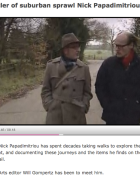
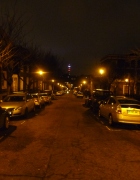
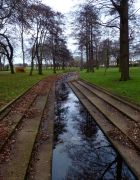
This video was shot on a walk for the episode on SPB Mais’s It Isn’t Far From London published in 1931, it it cut together with some audio excerpts from the radio show, where we diligently followed a walk through Stoke Poges, Burnham Beaches and Hedgerley described in the book.
In Mais’s day you could access Stoke Poges quite easily by pubic transport even on a Sunday, those days have sadly passed so we had to start our journey on foot in Slough and then tramp on through the dark winter evening in the acoustic footprint beside the M40 into Beaconsfiled.
You can download the podcast here
“Those who walk see most”
It was my co-host Nick Papadimitriou who introduced me to the expression ‘to do a Clunn’ in an email back in 2006. Nick did a no-show that night as I and three friends (including the redoubtable Peter Knapp) used Harol P. Clunn’s The Face of London (1932) to guide us from the Black Friar pub at one end of the bridge it lent its name to, along Queen Victoria Street finishing in the East End.
Clunn’s weighty tome is an exhaustive survey of London and its environs – probably the most comprehensive compendium of the city covered in this series exploring the world of early C20th topographical walking books. Clunn was a strident spokesman for the pedestrian – chronicling the gradual alienation of the walker from the streets to the designated walkways.
But unlike say SPB Mais or Gordon S Maxwell, Clunn is no poetic quasi-mystic, he is very much a scribe of the capital’s institutions and its worthies; as Nick observed looking down on the shimmering street-lit city, Clunn would have been the ideal guide for visiting dignitaries to London, proudly extolling the greatness of the colonial metropolis.
The walks in this book are epic – particularly for city perambulations which seem to peek at around six miles. Clunn’s measure more in the 10-15 bracket taking unlikely detours to extend what would be an otherwise moderate stroll. We baulked at this and decided to truncated his walk from City Road to Hampstead and back to St.Pancras to take in Highbury to Highgate – justifying it on the grounds that it had better rhythmic qualities for the radio.
I got lost in the graffiti of personal memory that decorates Highbury Fields and Barn for me. I lived here for a couple of years in the late 90’s in a tiny basement flat. Nick kindly indulged this and in return I offered up a few bits of local history that I’d gleaned from a pamphlet about the Highbury Barn pleasure gardens, which up till the mid-C19th had been a choice attraction for city day-trippers to sample operettas, eat cakes dipped in cream, custards, and syllabubs.
reading by Heidi Lapaine from The Northern Heights of London – Hampstead, Highgate, Muswell Hill, Hornsey and Islington by William Howitt, published in 1869
We pushed on and drunk in the view of the geological infrastructure of the northern heights laid bare as we stood on the corner of Aubert Park. For the first time I saw how Holloway sat deep in a river gully between what I think Nick would call the Hampstead masif and hills of Islington.
We achieved Stroud Green Road by dusk and supped tea in a cafe where Nick bemused a music teacher writing his journals with what must have seemed like an impossible knowledge of C20th English classical music. As we got sucked into the psychic vortex of Crouch End the powerful mythology of that place was debated. There are a perculiar amount of references to the undead round this nut-loaf of a separatist suburb – Will Self’s North London Book of the Dead has Crouch End as a place where you go to live after you die, Shaun of the Dead the great British zombie movie was filmed around here, Stephen King was inspired to write a short story called Crouch End after a walk along the old Northern Heights railway line, in the legend of the Highgate Vampire there is the fantastical story that the vampire moved out of Highgate Cemetery when it got too rowdy and shacked up in a large pile on the corner of Crescent and Avenue Roads, and in the real-world, serial killer Denis Nilsen committed some of his murders in a house on Cranley Gardens and allegedly kept the corpses for company.
field recording: Stroud Green Road
By the time we’d got bored mulling this over arguing about whether “murder and the occult was a short-cut to psychogeography”, we had ascended Shepherd’s Hill and were in Highgate. It was deep dark night and cold as a vampire’s kiss so we repaired to the Ye Olde Gatehouse pub, a place that legendary local author David Farrant claims is haunted. Sadly looks as if all the ghosts have re-located to Crouch End.

T L Bartlett’s The Story of Roxeth dates from 1948 and has been subsequently reprinted in paperback format. The dust jacket on the original depicts the author’s notion of a coat-of-arms which sums up the deep history of the old manor of Roxeth: A shield, divided into three parts–each containing a gloved hand and labelled with the names of one of Roxeth’s tithings–is crested by two rooks. Bartlett was clearly very proud of this little patch of apparently nondescript suburbia centred on South Harrow underground station and sets forth to do it justice in his highly unusual book.
download the podcast of this episode here
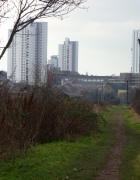
The first time I saw a copy of The Story of Roxeth was in 2000, shortly after becoming aware that South Harrow had an older and more resonant name. The book was on display in the window of a little second-hand bookshop in Ickenham (now sadly gone). Shortage of funds caused me to pass it by and I assumed I would never see another copy. Fortunately, David Tobyn, who runs the Walden Bookshop in Chalk Farm, picked up a copy two or three years back and passed it on to me.
Unlike other books we have looked at in the series, The Story of Roxeth is a local history. However, this isn’t your standard fare. The Story of Roxeth possesses a visionary quality born of Bartlett’s deep attachment to Roxeth, a place he both grew up and died in and in which he served as a local scoutmaster. Bartlett was the founder of The Friends of Roxeth, an organisation committed to transmitting the history and lore of the area to the thousands of new arrivals who had followed in the wake of the arrival of the Piccadilly line in 1935. The organisation was run from Bartlett’s semi-detached house at 91 Woodend Avenue.
field recording: Roxeth and the river valleys
Bartlett focused on the physical characteristics of the old parish of Roxeth, recalling his childhood experiences as a bird watcher out on Roxeth Marsh (now a municipal suburban open space). Indeed, bird life was of particular importance to Bartlett as he saw the loss of birds – particularly rooks – as symbolic of the eclipse of historical Roxeth by the then Harrow Urban District Council and the London Transport Passenger Board’s ‘South Harrow’. Mass housing inevitably followed on the arrival of the tube and this provided the material correlate to the loss of name as the old meadows, hedges and lanes were submerged beneath bricks and mortar.
Interspersed throughout the book are the scripts for a series of masques written for the scout troop of which he was master. They were originally produced and performed at the hall behind St Paul’s Church, Corbin’s Lane, in November 1945 to celebrate the eleventh centenary of the emergence of Roxeth as a recorded entity. 845 AD was the year in which Roxeth first ‘enters history’ via a Saxon manuscript describing how Werhard exchanged one cassate of land at ‘Hrocs Seath’ with Weremberht, a local thane. It is a further measure of the energy with which Bartlett pursued his project that he managed to persuade the Harrow UDC to finance the laying of two marker stones inscribed with the date. Bartlett was intent on preserving a sense of the name origins for Roxeth. Interestingly, his reading of these differed slightly from those given by J E B Gover in The Place-names of Middlesex (1942): according to Bartlett Hrocs Seath is Old English for ‘the Rooks’ heath’ and the alternative name of Roxey is derived from Hrocs-eye: ‘the marshy isle of the Rooks’.
The masques present historic figures associated with Roxeth: Leofwine, ‘the local landlord’ who, like his brother King Harold, fell at the battle of Hastings; William the First’s archbishop, Lanfranc, whose lands included Roxeth (and much of the rest of Harrow area – it was Lanfranc who built the church of St Mary’s at Harrow-on-the Hill, though it was consecrated by his student St Anselm); Chaucer, who Bartlett feels may well have visited Roxeth; and Thomas Beckett, who frequently stayed at the archbishop’s country retreat at Headstone Manor a little to the north of Roxeth. A recurring figure in the plays is the ‘Spirit of Roxeth’, a gaunt bearded character swathed in rags who carries a stave. The Spirit appears frequently across time and addresses the various luminaries, warning them not to destroy him or the place of which he is the spiritual guardian.
photo: Peter Knapp
Early on in the book Bartlett cites the theory presented by Sir Montagu Sharpe in Middlesex in British, Roman and Saxon Times (1919) that the positioning of Middlesex’s mother churches is based on Roman field shrines laid along the boundaries of pagi – Roman units of land surveyed by Julius Frontinus about AD 74-78. The present author tried to replicate Sharpe’s theory by converting the size of a pagi according to Sharpe to fit a 1/25000th OS map, drawing it on tracingpaper and placing it over the map. I would describe the results as indefinite… Incidentally, Sharpe was a co-founder of the RSPB together with WH Hudson and at one time a chairman of the Middlesex County Council. He thought that the name Roxeth derives from Hroces Seadum: a rookery.
T L Bartlett is the personification of everything I hated in my teens and twenties; a socially responsible and active member of his community with links to the church, local history and the scouts, and a devotee of the deep history of what is a – at first glance – a rather boring suburb – the sort of place I found suffocating and restricting in my teens. It is a measure of the way time changes us, that I now feel that Bartlett’s deeply rooted regional sensibility together with his commitment to good works in the name of his community approach a personal ideal.
field recording: Roxeth ambient
The particular feature of the area we looked at for the purposes of the programme was the little Roxbourne Stream, which flows from the lower slopes of Harrow-on-the-Hill down through Roxeth and South Ruislip towards its confluence with the Yeading Brook just south of Northolt Aerodrome. I first traced the Roxbourne from Harrow eight years back but only ever got as far as Victoria Road, that fine 1930s thoroughfare built by the Middlesex County Council, which runs close to South Ruislip station. Then, about four years back I decided to follow the Yeading from West Harrow down through Northolt towards Heathrow where the stream changes its name to the River Crane. Just south of Northolt Aerodrome, on the south side of Western Avenue, I located the confluence between the Yeading and the Roxbourne. What made the event particularly poignant was the discovery, just by where the rivers met, of an air vent mounted on a brick plinth and inscribed ‘Middlesex County Council’. Obviously main trunk sewers follow the river courses and unite at that point before rushing on towards the purification works at Mogden.
The intention to base the walk on a river led us to ask Tim Bradford, author of The Ground Water Diaries to join us in tracing the Roxbourne from South Harrow. Tim’s book is a well-researched though light-hearted survey of many of the streams now buried beneath the roads and alleyways of London. As is usual, John and I were also joined by our long-suffering photographer, Peter Knapp. Delays occurred on the day, caused by signal failure on the Piccadilly Line but eventually we set off from South Harrow station, following the railway north to where a large brick viaduct carries the line over what is clearly a river-gully formed by the Roxbourne’s course, though the stream is conduited beneath ground level at this point.
photo Peter Knapp
Next we turned westwards across Rayners Lane to the site of the old Newton Sewage Farm. It is here that a northern arm of the stream finally surfaces, running gently through a miasma of stumped willows, dried stems of woody herbs (it was November when we visited) and the first craws of the crows that frequent the area. Crossing Alexandra Road we entered the park that now covers the site of Roxeth Marshes. It was here that I had seen Crows in abundance on previous visits – though I rather doubted that they were Bartlett’s much-loved rooks. These birds had the heavy waddle and lack of gregariousness that I associate with carrion crows. Neither did they exhibit the distinctive ‘bald-patches’ above the beak that rooks usually have. (I should mention here that Bartlett makes a charming reference in his book to a crow named Merops, pet of Mrs Eliza Brightwen, owner in the 1890s of The Grove, a vast old building high up in Stanmore.)
Everybody was on form that day; Tim in particular spoke with clarity about his devotion to plotting the streams of the London area and, although he downplayed there being any ‘cosmic’ or mystical dimension to his studies, his druidic beard was a dead giveaway – this is a man who has immersed himself in stream-lore, who knows the rills, rillets, brooks, ditches and hatches of his zone and has correlated them with some vital component of his inner world. I had been aiming for us to get as far as South Ruislip that day. As it was, I had been grossly overoptimistic: both Tim and John had to split for home as childcare and job requirements summoned them. So, after a mere mile’s walk (which took us three hours) we headed north up Alexandra Road and, after admiring the 1930s cinema which is now a Zoroastrian Centre the boys took the tube home.
I wandered off, down along Rayners Lane and back to Roxeth. I then got lost in nameless suburbs never to be found again and ended up at Wood End, where the hill, upon which the old Post Office aerials are mounted, provided a heart-rending view at gentle dusk across the Brent Valley towards Hanger Lane and Ealing. That, however, is another story…
James Bone’s The London Perambulator published in 1925 gave me the title for the documentary that I made about my co-host Nick Papadimitrou (before we did this radio show together). I hadn’t thought about it that deeply at the time beyond the appropriateness of stealing a title from one of the topographical books we share a love of.
This opportunity to review the qualities of the book, that Nick confessed hadn’t read prior to the series, confirmed it was an apt association. Bone’s view of the city was idiosyncratic and hard to pin down, he was drawn to the overlooked and maligned corners of the metropolis. He dreamed of having the keys to the spirit of London and preached the virtues of night-time perambulations in all weathers.
For our urban ‘field trip’ we chose the chapter on North O’Euston, the only real geographically defined part of the book. Nick is lost outside the edgelands. Whenever I draw him to the more traditionally imagined London he looks slightly at odds with it and I start to wonder whether it is solely his psychic projections that hold places like Edgwarebury together and with him in NW1 they will slip through some kind of vortex into oblivion.
download the podcast of this episode here
On the other hand this is turf with which I am more familiar. I lived in a tiny flat atop Penton Mound for a number of years, lack of funds and the nature of life with young’uns meant that perambulating these streets (oft pushing a pram, and late night anxious-parent dashes to the out-of-hours GP at St.Pancras Hospital) was an essential part of my life.

Bone’s North O’Euston might now be called Somers Town. As self-proclaimed topographers we should know whether that name was in use in the early twenties when Bone was writing – but we don’t. It joins Notting Hill and Piccadilly in producing eponymous films when Shane Meadows set his Eurostar-funded film here.
The rendezvous for the walk was set by Nick as being by Paolozzi’s sculpture outside Euston Station. But such was the resident gloom that he and Pete merged into its gloopy form to such an extent that it took a phone call to locate each other yards apart. We gave in to the somewhat banal temptation to locate the position of the much-mourned doric arch of Euston Station and spooked a loitering commuter heading home to Nuneaton in the process. We then headed out into the streets around that still retained the “furtive, sinister spirit” described in The London Perambulator.
Bone saw this area, and that around the Euston Road’s sister stations of Kings Cross and St.Pancras, as being a “kind of debatable land”. This was a sentiment that we could only agree with as we ambled up Eversholt Street finding massage parlours, betting shops, a lap-dancing club and a shop supplying the needs of transvestites where Bone logged “pawnbrokers, bawdy houses, shabby hotels, and second-hand dealers”.
We were partially aided (or arguably handicapped) by a map in William Kent’s London For Everyman published at the same time as the Perambulator. I love this book and it was also auditioning for an episode in the second series of Ventures & Adventures should we be blessed with one. Using this beautiful colour plan we identified the “dingy crescent” where a notorious murder had taken place as Drummond Crescent, although Nick’s reveries here were abruptly interrupted by two young Spanish women trying to find the Place Theatre who wrongly assumed we might know where it was. We hadn’t the faintest idea and sent them off in the opposite direction, later to run into them, fuming and unappeased by my thoughts on how getting lost was the only way to truly experience a new city, “the production starts in five minutes” they countered.
Bone talked about how the population of this region moved about at night. Well that’s certainly changed, we barely saw a soul between Euston and Kings Cross as we drifted the backstreets often bickering about route, process and how I should indicate whether I was recording on the minidisc or not. I’d missed one of Nick’s quite wonderful riffs on how he first “moved to London from Finchley” as a callow youth – and he was none too pleased about it. I was just enjoying listening to him and momentarily forgot we were supposed to be recording for a radio show. I recorded virtually every foot-step and burp from then on.
field recording: st.pancras old church
We stopped in on St.Pancras Old Church surprised that it hadn’t got round to banning psychogeographers for their/ our appropriation of one of Christianity’s oldest sites as one of their/our most revered ‘nodules of energy’.
In Goods Way we saw how the scorched earth Kings Cross redevelopment had claimed the location of the flat in Mike Leigh’s brilliant film High Hopes, but has had the side effect of opening up one of the finest vistas of central London’s neon confetti.
It was around here that we lost Peter Knapp – consumed by the darkness around Kings Cross that has gobbled up so many wide-eyed adventurers. We now know that he emerged from this moloch unscathed, as his wonderful photos testify.
Through the new underpasses of ‘the Cross’, as the terminus in Sydney of the same name is known – also a place of prostitutes and bad drugs. We emerge in a shopping mall – no, it’s St Pancras Station, which seems to have borrowed its new ambience from Wood Green Shopping City as an ‘eff-off’ to Brunel’s Cathedral of the steam age.
field recording: kings cross – st.pancras
The walk would not have been complete without Nick correctly identifying a sewage system buried beneath an old covered alleyway leading off Phoenix Street. Our first obviously London and a night-walk chalked off in one.
Next, we’re off out to the fringes again in search of an ancient area seemingly populated by rooks. I’m taking extra minidiscs for this one, don’t want to end up tossed into the Roxbourne by a disgruntled deep topographer.
photos by Peter Knapp
To date we have not been able to discover the true identity of the Evening News’ walking guide, Pathfinder. Afoot Round London, his two volume collection published in about 1911 and his wartime rambles (published weekly in the paper – I possess a collection of these cuttings pasted into a little mauve scrap book that was issued specially for the purpose) explore areas around the capital that, in Pathfinder’s day, were still largely rural. It was our original intention to take a walk through the Cuffley Hills to Potters Bar as described in the volume of Afoot Round London dedicated to walks north of the Thames. However, a reconnaissance walk I undertook on my own several weeks back revealed that once the walk hit Cheshunt the route devolved down to endless car-dodging along B-roads, the margins of which consisted of new suburban homes complete with latticed windows providing discreet glimpses of white leather sofas and chunky TV sets within.
Download the podcast of this episode
There was nothing wrong with this of course. It could even be argued that the whole point of replicating Pathfinder’s walks a century on was to spot differences. Transport was a bigger problem: we agreed that the train journey from Finsbury Park to Gordon Hill – where the walk begins – was too time consuming, too difficult to fit around John’s busy family life and work schedule. An alternative was sought from the same volume and finally we settled on a long Epping Forest walk from Grange Hill, through Chigwell and Loughton and then via High Beech to Waltham Abbey.
It was with some trepidation that I waited on the forecourt of Grange Hill Station for John and Peter, our long-suffering photographer a couple of Sundays back : though the weather was fine – in sharp distinction to the previous night’s gale force winds and rain – I sensed that it was going to be difficult to complete the walk before darkness set in. My assumption – correct as it proved – was that none of us possessed the foresight to bring a torch and that the onset of evening would curtail the walk somewhere around Loughton. A further worry was that the little country lanes described by pathfinder would have become busy A- and B-roads, our perambulations being pushed to the margins of the roads by endless car journeys. In this I was also proved (largely) correct.
The team assembled and we set off east along the road uphill towards Chigwell Row. Within minutes we were forced to stop, held up by an astonishing view southwards across the Thames basin towards the Kentish Hills. It was a drear landscape we surveyed – everything in sight somehow aspiring to the oozy greyness of Thames mud. Far off to the right was the Canary Wharf complex as I had never seen it; a sullen attempt to humanise the land, looking like it was within inches of failing miserably. Due south were broad flats intersected by alternating bands of hedgerows, a glistening arterial road (the Eastern Avenue) and clusters of blocks and suburban houses (perhaps Barkingside or Seven Kings). I thought of Kathleen Raine’s descriptions of Essex suburbia in her autobiography Farewell Happy Fields and how she felt that such developments killed the poetic impulse. While John filmed me chattering to myself and Peter triggered off an endless run of pictures I found myself disagreeing with Raine: what I saw below and beyond was the unstable dream-like attempt to impose the human world upon the deep infrastructure of geology and time, a futile optimism in the face of the turmoil of politics and commerce. The enormous landscape challenged the temporary dream of the city and suburbia. It was the stuff that poetry feeds upon.
Staggered at the very beginning of our walk, and linked to Pathfinder through our awareness that he himself had commented on the view, we made our way to Chigwell Row. Here there is a pub called the Maypole. We laboured under the impression that this was the pub so named in Charles Dickens’s Barnaby Rudge. In fact that pub was based on the Tudor hostelry at Chigwell village named the King’s Head (when we saw it later, John instigated a serious discussion on whether the building was genuine Tudor - whatever topographical qualifications he and I imagine we possess, architecture definitely isn’t one of them!).
field recording: no path
Our plan was to cut sharply north westwards across land to Chigwell but we were foiled by a closed footpath and so we decided to walk due north along Pudding Lane and then due west to Chigwell along footpaths running parallel with the Roding valley. It turned out to be fortuitous that the path was closed because Pudding Lane was blocked to traffic and we had a half-mile of road pretty much all to ourselves. John got down into a ditch with his little sound-recording device and caught the busy rush of water for use in our radio programme while I stopped and admired the beaded berries of black bryony There were fine views eastwards across rolling Essex countryside towards Lambourne End. I wondered whether the little watercourse John was recording was the health-enhancing stream that temporarily gave Chigwell a reputation for healing waters during the nineteenth century. I am often intrigued by how streams – despite being overlooked – have to be actively accommodated through channelling, bridging and the scalding of ditches in February: they really are much more powerful and persistent then is generally realised. They have their history also, and it outlasts our paltry span, the ridiculous fashions and silly electronic devices that we imagine lift us to individualisation.
We turned west across fields, walking alongside a bank of blackthorn. We passed a rusting tractor and tall oaks. Northwards the sunlight lit up the orange rooftops of Loughton and Debden. I am intrigued by these towns along the Roding, the way they spin out into a parallel universe to my own Hampstead life: Places such as Loughton and Chigwell manage to ride the fine line between familiarity – they are instantly recognisable as a type to any contemporary English person – and the displaced. Here they are, clustering along the Roding as it turns east towards its source, little villages swollen by the advent of the electric railway; rural in aspect when seen against the classic English landscape and yet linked by mere minutes of journeying by train or M11 to London in its darkness over yonder. I watched the vast pools of sunlight shift from Loughton towards the black mass of the forest farther off and resolved to study this region more thoroughly.
John pulled ahead and then stopped short exclaiming ‘dead fox!’ There, resting by the track’s edge, by an oak tree and within inches of a sharp drop down into a hedge lined ditch lay the dead animal. Sun and wind had done a certain amount of work in drying out his body, yet the dark eyes seemed complete, somehow lagging behind the rest in the process of decay. Now they stared out at us accusingly. Something powerful had ruptured this little creature born of the earth’s surface, turning his body inside out. Dogs? A shotgun? Who knows, but either way I felt the townsman’s fury at his death. As we crowded round and I closed in with my digital camera for some portraiture, I sensed a further crime being committed: walloped by man-sized values and robbed of life for expediency or sport, Reynard was now being recycled in the name of more monkey business, his holy death picked up and travelling the airways via our radio show or blog. Consider this, please.
We edged through to Chigwell and then along Roding Lane – a car-thick terror sans footpath – passing the school and church until the drone of motorway filled the air and the road curved to a bridge over the M11 which was running down along the floor of the river valley. The further side brought us to dead roads and warehouses, a footpath round the attached car park leading through to a pretty little bridge over the Roding. The river had been a presence all afternoon, its course shaping the landscape in which we had walked. Now we saw it up close and stopped to admire its energy and importance as a factor in this Essex world. Rivers are my element and I silently paid homage to this grey god, winding its way towards the vast floodgate at Barking Creek (visible from Grange Hill earlier on) and Jenkins Lane before passing into the Thames.
field recording: B-Road
The land hereabouts was a veritable green utility with geese squonking away by the side of a filled gravel pit and dogs being walked everywhere. The locals were very friendly and I took the opportunity to check on a dispute that had been bubbling away below the surface all afternoon: John insists on pronouncing the name of the river rodding, whereas I favour the more refined roading. This difference had brought John and I to near blows at one point and it was only the yogic equanimity of Peter’s presence that had saved the afternoon. Clearly we needed to check this out with the locals and this I did. ‘Well, we say roading but you can say rodding too’ a kindly gentleman replied. That clinched it – I knew I was right.
We crossed sports fields towards suburban houses on the edge of Loughton and I became interested in a channelled tributary that hit the Roding close by. As we walked towards the underground station and began to discuss food I noticed the steam running alongside the road in a brick culvert. Such things draw me and I have a fanciful notion that others see me as a near-mythic river man, an ipsissimistic being who lives inside the water systems of our region and experiences the stories of our collected streams, ditches and hatches in a transtemporal manner. When I once broached this subject with John he looked aghast and began to edge away from me nervously, so I think there is more work to be done in that area. When I got home that night I researched the stream, using OS maps and JA Brimble’s wonderful London’s Epping Forest (1968 edition). Apparently this sizable watercourse is the only stream flowing westwards off of the Epping watershed: a northern tributary rises near the Wake Valley Pond (which it fills) and runs south to join a second stream cutting through Little Monk Wood. A second sub-set of streams rise on Shelley and Broom Hills and close to the Robin Hood public house before running north to join the Wake Stream. The collected waters then run down through Loughton to join the Roding.
This knowledge, gained after the walk, was as close as I got to Epping Forest that day: darkness thickened as we walked uphill into Loughton and a waiting Wimpy bar finished us for the day. We settled down to chips and various burgers and then made our way to the station and home.
field recording: watercourse/ wimpy bar
Video from the walk we did from Pathfinder’s Afoot Round London (1911). We plunged ourselves into the heart of the Essex Golden Triangle between Grange Hill and Loughton.
The reading is by Heidi Lapaine with music by Fabrizio Paterlini plus field recordings for the broadcast on Resonance 104.4fm.
Download the podcast of this episode
In this episode John and Nick take a topographical ramble through the pages of The Fringe of London by Gordon S. Maxwell published in 1925. They hold this book as being the holy text of suburban wayfarer. Includes field recordings of a trip to Monks Park near Wembley following Maxwell’s chapter on that suburb when it was a rural district. They also discuss Maxwell’s writing with Professor Kristen Bluemel.
Read more about our ramble around Monks Park below
John and I made our first field trip last Sunday, meeting as arranged at Stonebridge Park station, where we were joined by our photographer friend, Peter Knapp. Our aim was to explore Monks Park, an area described 85 years ago by Gordon S. Maxwell in The Fringe of London.
I arrived early and wandered around in the rain taking photographs of the little Wembley brook which has its confluence with the Brent just by the crossroads between the North Circular Road and Harrow Road after having run down from Sudbury, some way to the north. A sense of despondency settled on me as I waited for my companions, fuelled partly by the knowledge that I could never know enough about any given place to satisfy all the experts, the hungry and critical local historians, down at heel psychogeographers and various other miscreants.
photo: Peter Knapp
Peter arrived a little late and I spotted the bafflement on his face after hearing my potted outline about why we were meeting by the North Circular Road on a wet Sunday. The same thought crossed my mind; what exactly was drawing us out to this god-forsaken landscape with its droning arterial road, its sullen river running though concrete channels, its rows of suburban rooftops visible beyond the twisted ill-looking willows in the drab recreation ground?
Such is the nature of topographic exploration. Entering landscapes with an element of doubt as to what exactly is being looked for is a sure way to allow that space within which you can be moved and excited by what you find. As we set off west along the arterial road I recalled our first ever excursion together, back in 2005, in which John, Peter and I followed a 42 and 48 inch water main from Golders Green, down over the A5, through Gladstone Park in Neasden and along the south side of the North Circular to Wycombe Road, which is near Monks Park. This time we had another watercourse on our minds and as we entered the Tokyngton Recreation Ground we all commented on how powerful a presence the river Brent was.

As described in this blog’s previous entry, the banks of the Brent have been reshaped in recent years so as to more closely resemble the twists and turns one expects from a river. Extensive vegetation has been planted along the river’s length. This is a good thing as it creates ecotones, those transition zones between different plant communities used by wildlife for purposes of hunting or evasion. Most of the plant life consisted of native species, though at one point I did spot the dried ‘brolly’ stem of a Giant Hogweed standing defiantly amidst the nettles and willow suckers. As Peter snapped away at the river, swollen after the previous night’s rain, John and I discussed our plans: we decided to follow the park for a hundred yards or so and then slip through an exit into Monks Park itself, doubling back along the road to re-enter the park close to where we had originally come in. This we did, walking along the footpath as it wound ahead across improved grassland as is typical of urban parks.
photo: Peter Knapp
field recording from Monks Park 1
At one point I looked back the way we’d come and was astonished to see a dense mass of herbage and banks of tall willows shadowed by the vast office block at Stonebridge Park. It was a discordant meeting of the (apparently) old with the modern, the black shell of the building in fact predating the supposed rurality of the river bank. As I looked on, I felt myself rise into other people’s lives, Monks Park teenagers evolving into pram-pushers and workers, successions of hair styles and musical modes, lives flaying out from an imagined 1970s into the electronic density of our contemporary world.
Far ahead we glimpsed a few sultry couples walking with their kids on the sodden grass. A mewling gang of gulls fought mid-air for a pile of white bread deposited at the playground and a trouble-making crow slipped in beneath the airborne tussle, quickly making off with a crust. To our left we could see the Wembley Arch high over the rooftops. John and Peter thought this was most interesting but for myself, I don’t particularly get off on it – perhaps because I come from an area where views of the arch are commonplace.

photo: Peter Knapp
John looked particularly rugged as he leaned against a bench struggling with the sound equipment: As I secretly envied him his straggling red hair – so different to my own lifeless rug – I found myself wondering how exactly I had fallen in with a bunch of such interesting people, and how far I had travelled since the lonely days when I first developed an interest in topography.
field recording from Monks Park 2
I originally visited Monks Park in 1999, after buying my first copy of The Fringe of London. Having checked that there was still a place called Monks Park using my 1957 edition of the Geographer’s Atlas of Greater London, I took the 245 bus from Golders Green down to Neasden, intending to approach my quarry via the Brent. I set off across some grassland from Kingsbury Lane, walking just behind the Metropolitan Railway ‘village’ formed by Quainton, Verney and Chesham Streets.
I threaded through, following the stream until it came to the long embankment of the underground line and disappeared into a tunnel below. Never being one to shirk my topographical responsibilities I dropped down into the water and, taking my torch from my knapsack, entered into the darkness. Deep below the railway line the waters rose until they passed my waste and I had to hold torch, map and copy of Fringe of London aloft, my hands brushing the roof of the tunnel. Apparently some of the locals claim that the tunnel is inhabited by a creature born of the relationship between a farmer and a goat – though whether this is truly local in origin (the area was still farmed into the 1930s) or is the product of somebody having watched to many 1970s Hammer horror films I cannot say. Either way, I didn’t see any goat-man, scared though I was.
excerpt from the introduction to The Fringe of London by Gordon S. Maxwell – read by Heidi Lapaine
I ended up on that occasion in a wasteland behind Fourth Way, part of the Wembley Trading Estate. It was a madness of industrial detritus and sickened elders clogging the river’s bank. As I squeezed my nose to block the smell emanating from the Middlesex Meat Company my copy of Maxwell’s book tumbled into the Brent and floated beneath an overhanging section of the riverbank formed of old tyres and rotting stacks of sex mags.

I thought about this now as I watched John tinkering with his rudimentary sound equipment. Much as I appreciate my friends, there is a quality to walking alone that takes me out of communal time into a zone that seems to be the land’s time only. We turned out of the park and into the actual street named Monks Park and looked over at some little houses, a date-plaque on one of these inscribed 1916. Maxwell presents the street in his book as a rural community rather than a rustic one and at one point discreetly lets slip that the houses thereabouts weren’t very old by stating that ‘some of them are already clad with creepers’ (emphasis mine). I wonder if these little homes, all in a row, weren’t built for munitions workers, but I have not been able, to date, to determine whether this is so or not. John ribbed me mercilessly over the street being named in large steel lettering on the wall of a health centre, as if I had ever argued that the place would be difficult to find. John however is a psychogeographer, a species renowned for their arrogance and intractability. I suspect we all found it pretty dull and at this point talk began to hinge on whether we shouldn’t make for Neasden IKEA for a meal of meatballs and chips. In particular, Peter was outspoken concerning this possibility. I hadn’t realised that IKEA served meatballs, a further indication of how ‘deep’ my Deep Topography really is: follow my methods and I guarantee you, you will end up seriously dissocialised (and with no money to boot!).
field recording from Monks Park 3

photo: Peter Knapp
So that was it really: we followed the river eastwards towards the trading estate, past a section where the sward widened out to views of 1930s semi-detacheds silhouetted against the evening sky. It was a mythic suburbia we entered, all of us moved by the mute pathos of a disused bowling green slowly disappearing under sprouting strands of Canadian fleebane and Michaelmas daisy. Later the park evaporated as the route narrowed to a footpath following the river. We entered echoing railway tunnels and murky confluences (where the Lidding or Wealdstone brook hits the Brent) and ravings of knotweed and Himalayan Balsam. We made it to IKEA eventually, after traipsing up by the Neasden TFL depot (note the Planta genista growing over beyond the tracks) and through to the furniture store via a bridge over the canal feeder, which was clogged with duck weed, or ‘Jenny green teeth’ as we call it in Middlesex.
After the meal I tried to describe to the boys how I had once seen numerous specimens of Water dropwort growing behind the steel palings of a factory close by. Each plant had been covered with snails, apparently immune to the poisonous leaves and stems. However, John and Peter seemed more intent on catching their respective buses so I saw them off and was left standing alone in the dark car park, the rain ticking against my waterproof jacket.
This episode will be repeated on Monday 16th November 10 – 10.30pm – the podcast is available from Resonance 104.4fm